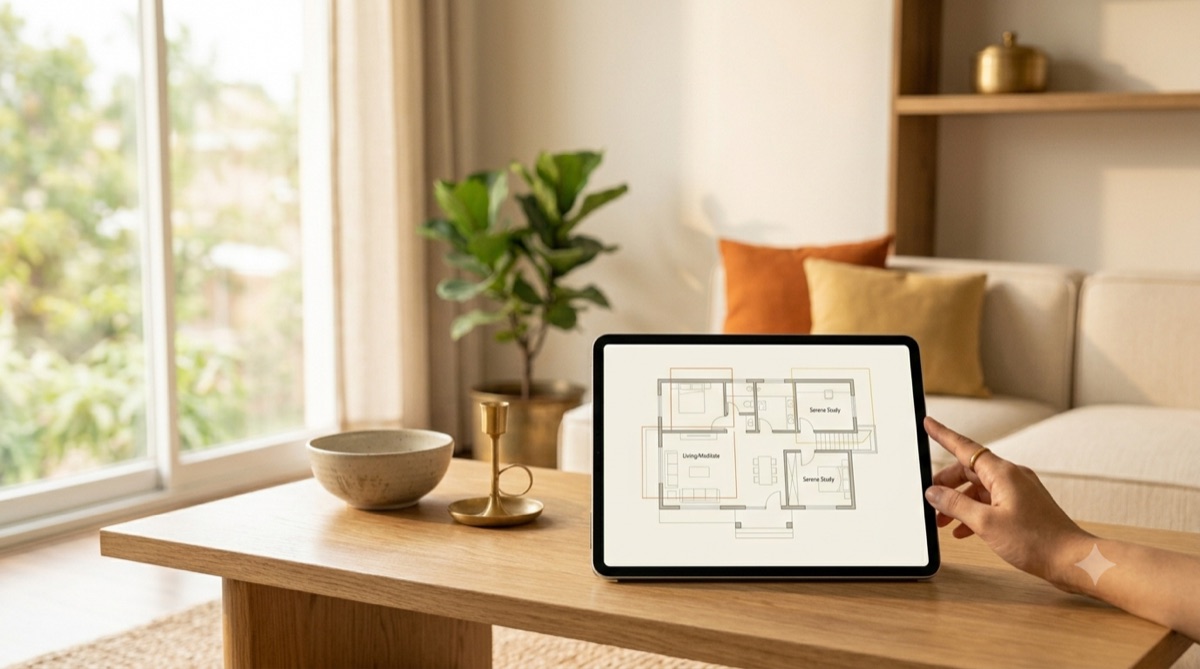
Traditional Vastu analysis means a consultant visiting your home, measuring directions, and interpreting the layout by hand. Vastu Sense does the reading in minutes from a floor plan — but it's worth understanding what the AI does, and (just as importantly) what it deliberately doesn't.
Step 1: Reading the plan
When you upload a floor plan — a photo, a scan, or a PDF — a vision model examines the image and identifies the rooms: which rectangle is the kitchen, which is a bedroom, where the entrance and bathrooms are. It's doing the same recognition a person would, just faster and consistently every time.
Step 2: Fixing the directions
A layout is only half the picture; Vastu is about orientation. You tell the app which way the plan faces (or, on Premium, record a short compass-guided video walkthrough and the app works out the directions for you). Now every room is mapped to a real compass zone — kitchen in the South-East, master bedroom in the South-West, and so on.
Step 3: Scoring — and why it's not the AI's opinion
This is the part we're most deliberate about. The score does not come from an AI model. It comes from a deterministic rule engine — a fixed set of classical Vastu rules encoded in software. Given the same rooms, directions, and residents, it produces the same score every single time.
That matters for two reasons. First, consistency: two people scoring the same home won't get different answers, and neither will we. Second, trust: a language model can sound confident while being wrong, so we never let one invent a number. Scores are calculated, not guessed.
The dividing line: AI is used to read your plan and to write the explanations in plain language. The actual Vastu score and remedies come from a transparent rule engine — never from an AI's guess.
Step 4: Explaining it in plain English
Once the rule engine has the score and the specific issues, AI is used again — this time for language. It turns the raw findings into readable descriptions and remedy explanations, personalised to who lives in each room. No jargon, no Sanskrit you have to look up — just what's working, what isn't, and what to do about it.
Personalised, because homes aren't generic
The same flat scores differently for different families, because the analysis considers who sleeps where and what each person's focus is — rest, study, career, or calm. That's something a one-size-fits-all checklist can't do, and it's why the report feels like it's about your home rather than a template.
No pandit visit, no prior Vastu knowledge, and a result you can actually act on — in about ten minutes.